• Skip to primary navigation
  • Skip to main content
  • Skip to primary sidebar

ECC Management System

Enabling our Mission ... To help people experience God's love.

  • HOME
  • Administration
  • Leadership
  • Human Resources
  • Execution
  • Continuous Improvement
  • Arts
  • eKids
  • ESM
  • Finance
  • Groups
  • Intercultural
  • Operations
  • Outreach
    • Missions
  • Teaching
    • Pastoral Care

Kevin Stone

Chart of Accounts

December 29, 2024 By Kevin Stone

Department Numbers

Ministries

3030 – Outreach
3040 – Teaching
3050 – Student Ministries
3060 – Arts
3070 – Children’s Ministry
3080 – Groups
3200 – Connections

Operations

3011 – Administration
3012 – Facilities
3013 – Finance
3014 – Human Resources
3015 – Information Technology
3090 – Christian Preschool

International Missions

3333 – Kenya
3334 – Panama
3336 – Israel

Campaigns

4050 – Campaign One
4060 – Campaign Two

Account Numbers

001 · Advertising and Marketing
002 · Background Checks
005 · Business Expenses
007 · Church Planting
009 · Classes
010 · Cleaning Services
011 · Missions

011 – 05 · Missionary Support
011 – 06 · Mission Trips

012 · Computers and Software

012 – 07 · Services and Support

013 · Conferences
014 · Contractors
015 · Curriculum
018 · Equipment
019 · Human Relations
020 · Equipment Leases
021 · Events

021 – 09 · VBS
021 – 56 · Stretch

025 · Insurance
033 · Postage
035 · Production
036 · Rent
037 · Guest Services
039 · Salaries
040 · Subscriptions
041 · Supplies
042 · Training and Development
043 · Travel
044 · Utilities

044 – 24 · Gas and Electric
044 – 25 · Water and Sewer

046 · Website Management
049 · Construction
051 · Internet and Phone
052 · Repairs and Maintenance

052 – 49 · Facilities
052 – 50 · Site
052 – 52 · Vehicles

053 · Security System Monitoring
058 · Scholarships
061 · Vehicles

061 – 53 · Fuel
061 – 54 · Loan
061 – 55 · Insurance

062 · Recruiting
063 · Consulting
064 · Waste Removal
072 · Childcare
Filed Under: Execution, Finance, Forms

The Performance Cycle

December 29, 2024 By Kevin Stone

Introduction

Developing infrastructure is the single most significant role of the leader of a growing organization.  But with all the demands on the leader, how does it have a chance of actually happening?  The Performance Cycle is a leadership model that provides the leader with the framework from which to develop a strong, stakeholder focused, infrastructure.  And, it’s simple enough to be easily understood by everyone.  It can also be used at any level in the organization, regardless of the challenge.

It’s all about scalability!  How can an organization leverage its knowledge and leadership?  There are only so many leadership people to go around and good leaders are extremely difficult to find.  So … building a world-class organization depends on the leader’s ability to develop good systems, processes, and methods and to make them known (easy to access, learn about, use, and change as needed) to the entire organization.  Unfortunately, this is a foreign concept to many leaders!

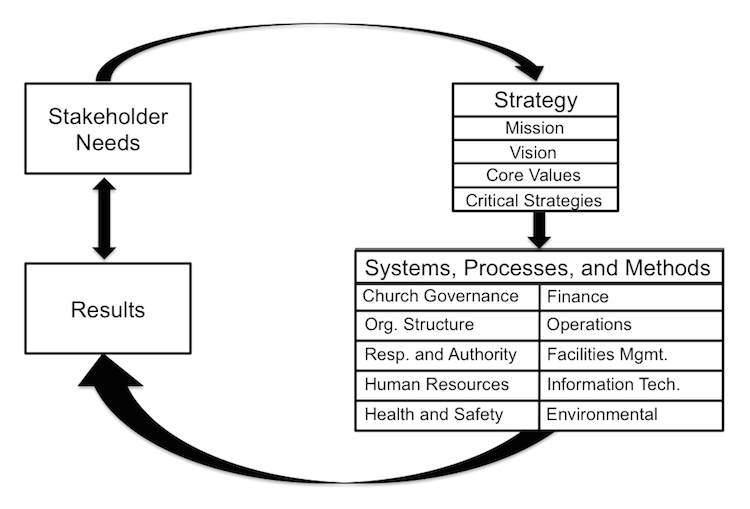
In short, The Performance Cycle is a model (below) for developing organizational infrastructure.Alignment is the goal. Is the Strategy aligned with the Stakeholder Needs? Are the Systems, Processes, and Methods aligned with the Strategy?

Stakeholder Needs

How does it work? It starts with working to understand Stakeholder Needs. The question is “Who are the stakeholders and what are their needs?” You might be wondering at this point what is meant by the term stakeholder. A stakeholder is the group of people with a stake (interest, benefit, concern, etc.) in the organization or endeavor.  In the church the obvious most important stakeholder is Jesus. In addition to Jesus, the community at large, the target group, attendees, volunteers, members, elders, and church staff are also stakeholders. Prayer, Bible study, demographic studies, surveys, and staff team experiences are all important tools in developing a thorough understanding of the needs of the stakeholders.

Strategy

Once an understanding of Stakeholder Needs is achieved, it’s time to develop a Strategy to meet the needs. What is the church going to do to meet the needs of the stakeholders? It’s pretty simple. Jesus told us that we must Go, Baptize, and Teach (Matt 28:18-20). Another example would be determining and understanding the “felt needs” of the target group and designing “experiences” that are designed to address those needs.

The Strategy is made up of a mission, vision, and a set of critical strategies the church will implement/accomplish to satisfy the stakeholders.

Systems, Processes, and Methods

Now that a Strategy has been developed and documented, leadership must create and implement systems, processes, and methods that accomplish the Strategy. Systems, processes, and methods are most often implemented via a Management System or some similar structured approach. The Management System is the backbone of the Performance Cycle. It’s the vehicle for ensuring that systems, processes, and methods are consistent, compatible with one another, and known by everyone in the church … especially new people. The Management System is a topic unto itself.

Results

How is leadership going to know how well the church is meeting its Stakeholder Needs? The answer is simple … through measuring results. It’s critical that the leaders in the church create measures that provide “at a glance” visibility of results (performance). If you’re not measuring it, you probably aren’t managing it. A great method for measuring results is to establish Key Performance Measures (KPMs) that are updated and reviewed by everyone on the team on a regular basis. For example, a graph showing “average weekly attendance” over time would be a good KPM.

Corrective Action (Diagnosis)

What happens when a measure shows that something isn’t working … isn’t meeting a Stakeholder Need? It’s pretty simple. Leaders must go into diagnosis mode, reversing the arrows on the Performance Cycle.

The first place to go is the Systems, Processes, and Methods box. Is there something that the church is doing (or not doing) that is causing a measure to go in the wrong direction? If the problem can’t be found in that box, the team must continue up to the Strategy box. Does the Strategy truly address the Stakeholder Need? What should be changed or tweaked? And if that’s not it, does the church really understand its stakeholders and their needs?

Filed Under: Leadership Responsibility, Position Papers

Staff Policy Manual

December 27, 2024 By Kevin Stone

Table of Contents

  • Introduction
  • Staff Acknowledgement
  • Nature of Employment
  • Equal Employment Opportunity
  • Disability Accommodation
  • Immigration Law Compliance
  • Outside Employment
  • Hiring of Relatives
  • Staff Relations
  • Ethics and Conduct
  • Contact with the Opposite Sex
  • Nondisclosure
  • Conflicts of Interest
  • Introductory Period
  • Employment Classifications, Categories, and Staff Designations
  • Job Descriptions
  • Compensation
  • Work Schedules
  • Timekeeping
  • Pay Periods
  • Overtime Pay
  • Staff Health and Other Benefits
  • Benefits Continuation (COBRA)
  • Workers’ Compensation Insurance
  • Vacation
  • Holidays
  • Flex Weeks
  • Family Leave
  • Bereavement Leave
  • Jury Duty
  • Witness Duty
  • Time Off to Vote
  • Sabbatical Leave
  • Staff Conduct and Work Rules
  • Alcohol and Drug Use
  • Personal Appearance
  • Sexual and Other Unlawful Harassment
  • Performance Evaluation
  • Access to Personnel Files
  • Personnel Data Changes
  • Smart Phones
  • Computer, E-Mail, and Internet Usage
  • Social Media, Blogs, and Other Online Forums
  • Workplace Monitoring
  • Business Expenses
  • Use of Equipment
  • Safety
  • Smoking
  • Employment Termination
  • Resignation


Filed Under: Human Resources, Policies Tagged With: staff policy manual

Executive Pastor Job Description

December 15, 2024 By Kevin Stone

General Description

The Executive Pastor is responsible for the overall leadership and direction of church staff, leading all functional areas in the accomplishment of the church’s mission. This includes outreach, arts, pastoral care, group life, student and children’s ministry areas as well as strategic planning, finance, administration, human resources, and operations.

Essential Job Functions

  1. Support the Senior Pastor in the accomplishment of the church’s mission through ministry effectiveness evaluation, discernment, decision making, planning and overall direction of church staff.
  2. Lead the ministry staff in the establishment and ongoing direction of ministries that effectively reach the church’s demographic, insuring the accomplishment of the overall mission.
  3. Ensure the operational readiness of the church through leadership and oversight of the support staff performing duties in administration, finance, human resources, supply, and facilities management.
  4. Facilitate the annual strategic planning process including evaluation of ministry performance; review of mission, vision, and core values; development of key objectives and tactics; and establishment of three year goals.
  5. Establish and maintain a set of key performance measures (KPMs) that provide the Senior Pastor and church staff with ongoing visibility of the effectiveness of all functional areas of the church.
  6. Develop annual financial plans that fund the accomplishment of the strategic plan and meet critical financial objectives such as established cash reserve levels.
  7. Lead church planting efforts including development of a strategy, networking with other church planting focused churches for funding and provision of other needed resources as well as identification, development, and leadership of lead church planters.
  8. Champion the development of infrastructure by all ministry and support areas that supports healthy, long-term growth of the church.
  9. Lead the church’s building programs including capital fund raising campaigns, master planning, design and architecture, contractor selection, and construction.
  10. Perform other duties as assigned.

Education and Experience

This position requires a minimum of 10 to 15 years of experience as a senior leader in a corporate business environment. Possession of a Bachelor’s Degree in Business, Technology, or other related field is required. Master’s work in Biblical studies is a plus. The successful individual must have a proven track record of effective leadership, judgment, and above reproach character.

Position Structure and Level

Grade: TBD
Reports To: Senior Pastor
Classification: Exempt
Category: Regular Full-Time
Staff Designations: Executive Staff, Senior Staff, Ministry Staff, Administrative Staff

Related Documents

Compensation Program
Directory of Job Descriptions
Staff Policy Manual
Staff Policy Manual – Job Descriptions Section

Filed Under: Administration, Human Resources, Job Descriptions Tagged With: executive pastor

Staff Member Start Dates

January 11, 2024 By Kevin Stone

Name

Part-Time Start Date

Full-Time Start Date

Name

5/26/2015

5/1/2017

Name

N/A

11/1/2017

Name

N/A

8/10/2015

Name

9/7/2021

N/A

Name

N/A

1/1/2014

Name

N/A

9/1/2019

Name

N/A

6/1/1999

Name

N/A

6/16/2020

Name

1/1/2011

4/1/2011

Name

1/1/2021

8/1/2021

Name

N/A

4/5/2004

Name

11/1/2000

4/1/2003

Name

N/A

10/1/2015

Name

N/A

5/27/2014

Name

5/24/2010

N/A

Filed Under: Human Resources

  • « Go to Previous Page
  • Page 1
  • Interim pages omitted …
  • Page 3
  • Page 4
  • Page 5

Primary Sidebar

Login Status

Document Types

  • Management System Manual
  • Bylaws
  • Strategies
  • Policies
  • Position Papers
  • Organizational Charts
  • Operating Procedures
  • Work Instructions
  • Job Descriptions
  • Ministry Descriptions
  • Forms
  • Resources
  • Key Performance Measures (KPMs)

Tags

executive pastor KPM planning staff policy manual strategic plan

Recent Additions

  • Cash on Hand
  • Giving by Type
  • Outside Support
  • Giving Per Capita
  • Average Weekly Giving

Return to top of page


Copyright © 2026 Ministry Management System · Log in